Most Important Guitar Chords Chart: Free Essential Guide

Most Important Guitar Chords Chart access is the single fastest shortcut for any beginner guitarist looking to play hundreds of popular songs without getting bogged down in complex music theory. Learning to play the guitar can feel overwhelming when facing hundreds of fretboard combinations, but the truth is that a small handful of open chords forms the foundation of modern music.
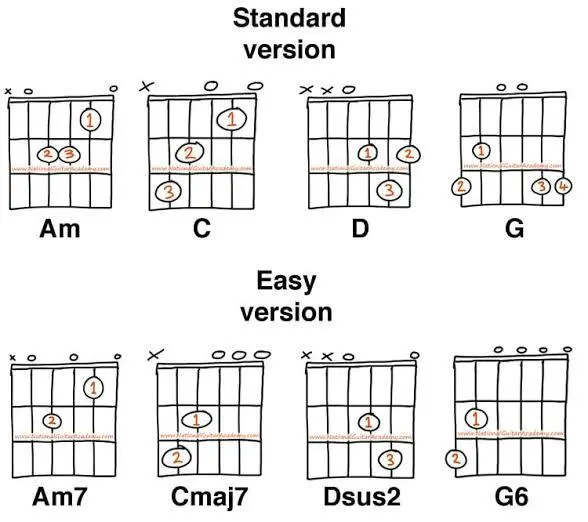
most important guitar chords
Most Important Guitar Chords (Source: National Guitar Academy

Why You Need the Most Important Guitar Chords Chart

When you start learning guitar, memorizing every single chord standard variation isn’t necessary. Instead, focusing on a curated most important guitar chords chart lets you build finger strength, muscle memory, and smooth rhythm transitions early on.

By mastering just 8 fundamental open chords—often called the “essential cowboy chords”—you gain the ability to play over 80% of pop, rock, folk, and country songs. These core shapes include:

  • Major Chords: C Major, A Major, G Major, E Major, and D Major (often remembered by the acronym CAGED).

  • Minor Chords: A Minor (Am), E Minor (Em), and D Minor (Dm).

Having a visual reference sheet pinned to your wall or saved on your tablet drastically speeds up your practice sessions by eliminating constant online searches while tuning up.

Essential Chords Included in the Most Important Guitar Chords Chart

1. The Essential Minor Shapes (Em, Am, Dm)

E Minor and A Minor are usually the easiest shapes for complete beginners because they require only two or three fingers. They offer a deep, rich sound and serve as the backbone for countless acoustic ballads.

2. The Core Major Shapes (C, G, D, A, E)

Major chords produce a bright, happy tone. The transition between G Major, C Major, and D Major is arguably the most famous chord progression in modern music history. Mastering these three shapes alone opens up hundreds of playable song charts.

3. Dominant 7th Shapes (E7, A7, D7, C7)

Once you feel comfortable with open major and minor shapes, blues and funk rhythms require seventh chords. Dominant 7th shapes add tension and color, making your strumming sound vastly more dynamic.

Most Important Guitar Chords Chart Download Free PDF
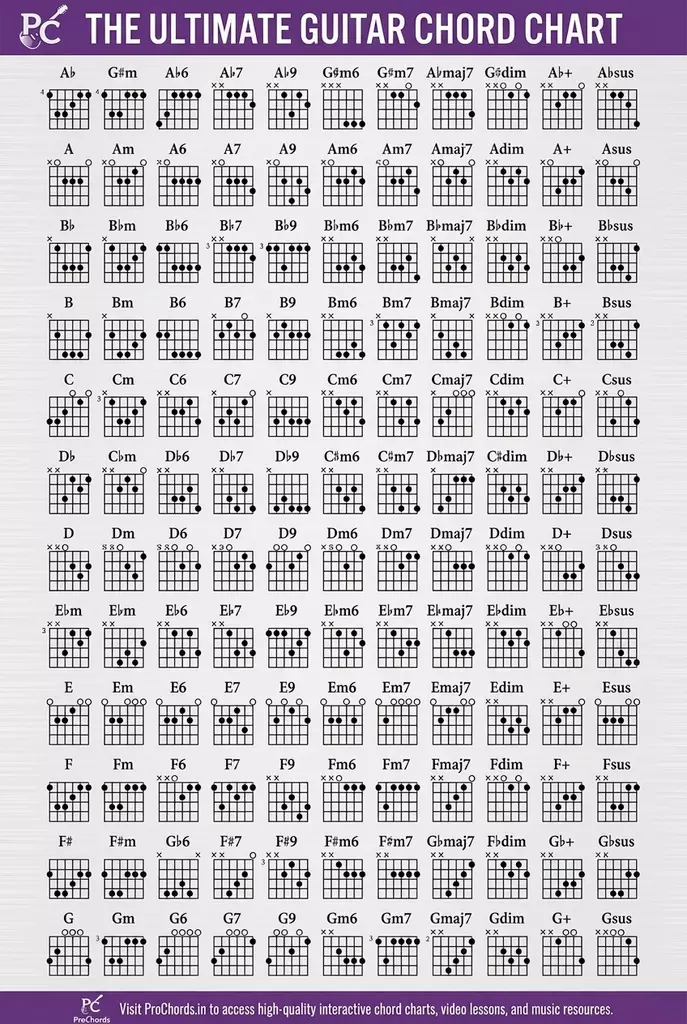
Most Important Guitar Chords Chart Download
Most Important Guitar Chords Chart Download (Image: Prochords)

Having a portable reference card makes practice seamless wherever you bring your instrument. You can grab a high-resolution printable version of the most important guitar chords chart download free to keep inside your guitar case or desktop folder.

Having a physical copy during daily practice helps eliminate screen distractions like notifications, keeping your focus purely on clean finger placement and clear string ringing.

Easy Guitar Chords For Beginners: 7 Simple Chords to Master Fast

How to Practice Using Your Guitar Chord Reference

To make the most of your visual chord chart, follow this simple daily warm-up sequence:

  1. The Clarity Test: Form a chord shape, then pluck each string individually. If a string sounds muted or buzzes, adjust your fingertip position closer to the fret wire.

  2. Anchor Finger Drills: Identify fingers that remain on the same string when shifting between two chords (for example, the index finger when moving from C Major to A Minor).

  3. 1-Minute Switches: Set a timer for 60 seconds and count how many clean transitions you can make between two shapes (such as G Major to D Major).

For interactive lessons and deeper theory breakdowns on finger positioning, check out free educational resources like JustinGuitar or explore foundational guides on Fender Play.

The Ultimate Guide: Which Guitar Is Best for Beginners?

Start Strumming Today

You don’t need years of formal training to start playing real music on the guitar. By focusing on a clean, accessible most important guitar chords chart, you streamline your learning curve and stay motivated. Print out your reference sheet, grab your guitar, and practice switching between these fundamental shapes every day!


Learn Guitar in a Month? The Shocking Truth And Proven Blueprint

Is it actually possible to learn guitar in a month, or better yet, in 7 days?

If you browse YouTube or TikTok, you will find hundreds of clickbait videos promising to transform complete beginners into shredding rockstars in less than a week. But when you pick up an acoustic or electric guitar for the first time, your fingers hurt, your chords sound muted, and rhythm feels completely unnatural.

So, what is the honest truth? Can you learn guitar in a month, or are those rapid transformation claims pure myth?

In this comprehensive guide, we unpack what is genuinely achievable in 7 days versus 30 days, break down a realistic 4-week practice schedule, and give you the exact steps to play your first full songs faster than you thought possible.

Practicing open chords on an acoustic guitar. Source JamPlay.com

What Does “Learning Guitar” Actually Mean?

Before answering if you can learn guitar in a month, we need to define success. Learning guitar is not a binary switch—it is a lifelong continuous spectrum.

  • In 7 Days: You can learn 2 or 3 basic open chords (like E minor and A major) and play a slow, single strumming pattern. You will not be playing full songs fluently yet.

  • In 30 Days: You can master 4 to 6 core open chords, transition smoothly between them, lock into a steady rhythm, and play dozens of popular pop, rock, and folk songs from start to finish.

  • In 6 Months to 1 Year: You gain fluency with barre chords, basic solos, dynamic strumming, and fingerpicking patterns.

If your goal is to strum along to popular songs around a campfire or play your favorite acoustic tunes, you can absolutely learn guitar in a month with disciplined, daily practice.

Can You Learn Guitar in 7 Days? The Realistic Expectations

If you only have 7 days, set realistic expectations to avoid frustration. Building muscle memory and developing fingertips calluses takes time.

Here is what a realistic 7-day milestone looks like:

Day Practice Focus Realistic Goal
Day 1–2 Holding the guitar, tuning, pressing frets Clear single notes without buzzing
Day 3–4 Learning E Minor (Em) and A Major (A) Switching between 2 chords under 5 seconds
Day 5–6 Basic down-strum rhythm (4 beats per bar) Playing in time with a metronome
Day 7 Combining chords + basic strumming Strumming a simple 2-chord loop

While 7 days gives you a solid taste of the instrument, attempting to master full songs in a week usually leads to finger soreness and technique bad habits. Giving yourself a full 30-day window yields far better, long-lasting results.

The 4-Week Blueprint: How to Learn Guitar in a Month

To successfully learn guitar in a month, you do not need 4 hours of daily practice. In fact, 20 to 30 minutes of focused, daily practice is vastly superior to a single 3-hour marathon on Sunday.

How to Learn Guitar in a Month

Follow this structured weekly progression to maximize your progress:

Week 1: Foundation, Mechanics & First Open Chords

  • Focus: Instrument setup, finger placement, and the open chords Em, C, and G.

  • Key Technique: Keep your fingers arched and press right behind the fretwire to avoid string buzz.

  • Pro Tip: Use an online tuner like Fender Tune before every single practice session to train your ear.

Week 2: Smooth Chord Transitions & The Magic 4-Chord Combo

  • Focus: Add the D Major chord to your toolkit.

  • Key Technique: Practice the “1-Minute Chord Changes” drill. Pick two chords (e.g., G to D) and count how many times you can switch smoothly in 60 seconds.

  • Goal: Reaching 30 clean transitions per minute unlocks hundreds of songs!

Week 3: Master Rhythm and Strumming Patterns

  • Focus: Transition from simple down-strums to the iconic Island Strum (Down - Down-Up - Up-Down-Up).

  • Key Technique: Keep your strumming wrist loose and relaxed. Maintain continuous hand movement even when you aren’t hitting the strings.

Week 4: Playing Your First Complete Songs

  • Focus: Putting rhythm and chord transitions together into full song structures (Verse, Chorus, Outro).

  • Songs to Try:

    • “Riptide” by Vance Joy (Am, G, C)

    • “Stand By Me” by Ben E. King (G, Em, C, D)

    • “Knockin’ on Heaven’s Door” by Bob Dylan (G, D, Am / G, D, C)

  • Resource: Search chord sheets on Ultimate Guitar to practice along with lyrics.

Guitar Chord Chart for Kids: Super Easy Beginner Chords to Learn Fast

4 Crucial Tips to Learn Guitar Fast Without Quitting

1. Build Finger Calluses Early

During your first two weeks, your fingertips will feel tender. This is completely normal. Practice daily for 20 minutes rather than long sessions to build protective calluses naturally without blistering your skin.

2. Don’t Skip the Metronome

Rhythm is 80% of music. Playing the right chords with bad timing sounds messy, but simple chords played with great rhythm sounds fantastic. Practice with a free metronome app set to 60–70 BPM.

3. Leverage High-Quality Free Lessons

You don’t need expensive private tutors right away. Structured free platforms like JustinGuitar offer world-class beginner courses that guide you step-by-step through your first month.

4. Practice Slow to Play Fast

When learning a new chord progression or song, slow down to a crawl. Precision creates muscle memory; speed comes automatically once your brain maps the movement.

Final Verdict: Is 30 Days Enough?

So, can you learn guitar in a month?

Yes! While you won’t be playing lightning-fast solos or complex classical pieces in 30 days, a dedicated month of practice is more than enough time to master fundamental open chords, strum rhythmically, and confidently play dozens of iconic songs.

Stop waiting for the “perfect time”—grab your guitar, commit to 20 minutes a day, and start your 30-day journey today!


Easy Guitar Chords For Beginners: 7 Simple Chords to Master Fast

Guitar chords for beginners are the perfect place to start when you first pick up a guitar. Imagine you’ve got your guitar in hand, fingers ready, and pick waiting. Then the question hits: “What do I play?” The answer is almost always chords.

Chords are the building blocks of music. They create harmony and give songs their emotional feel. Without them, most music would sound incomplete. Nearly every instrument uses chords in some form (except drums, which focus on rhythm, and bass, which often emphasizes single notes and depth).

If you’re just starting guitar lessons for beginners, learning a handful of basic guitar chords opens the door to hundreds of songs. In this guide you’ll learn the most useful beginner guitar chords, how to read chord diagrams, practical finger tips, and a list of easy songs you can play right away.

Why Guitar Chords Matter for Beginners

At schools like School of Rock, students learn chords early because they apply immediately to real songs. Rhythm guitarists use chords for strumming and fingerpicking, while lead players still need them for song structure. Whether you play electric or acoustic, these shapes form the foundation of rock, pop, folk, and more.

Power Chords – The Simplest Starting Point

Power Chords
Power Chords (Source: Fender)

Power chords are often the first guitar chords for beginners that feel exciting. They use only two or three strings and require minimal finger strength.

These chords sound especially powerful on electric guitars with a bit of distortion, giving that classic rock edge. You can play them on acoustic too, but they really shine with overdrive. Power chords are movable — once you learn the shape, you can slide it up and down the neck to create new ones.

They appear in countless rock and modern songs, making them one of the most practical basic guitar chords to master early.

Open Chords – The Heart of Beginner Guitar Playing

Open chords (also called open-position chords) are perfect for beginners because they include open strings that ring freely. Your fretting hand only presses a few strings while the others stay open.

These are often called CAGED chords because the main shapes are C, A, G, E, and D. Most songs beginners learn rely heavily on these shapes. They require fewer fingers than barre chords and feel more natural at first.

Barre Chords – The Next Step (Save for Later)

Barre Chords
Barre Chords (Source: Prochords.in)

Barre chords are more advanced. You use one finger to press multiple strings across a single fret, then form a shape that can slide anywhere on the neck. They are extremely useful once your hand strength improves, but most guitar lessons for beginners introduce them after open and power chords feel comfortable. We’ll focus on open chords first.

How to Read Chord Diagrams for Beginner Guitar Chords

A chord diagram is a simple map of the guitar neck. Picture the guitar standing upright in front of you:

  • An “X” above a string means don’t play it (mute it).
  • An “O” means play the string open.
  • Numbers show which finger to use: 1 = index, 2 = middle, 3 = ring, 4 = pinky.
  • The horizontal lines represent frets. The top line is the nut (or first fret if numbered).

For example, in an A major chord, your fingers sit on the second fret of the D, G, and B strings.

Note: Chord diagrams and tablature look different. In tab, the bottom line is the low E string and numbers tell you the fret. Don’t mix the two systems.

Essential Open Guitar Chords for Beginners (CAGED Plus a Few More)

Here are the core beginner guitar chords you’ll use constantly:

  • C Major
  • A Major
  • G Major
  • E Major
  • D Major
  • A Minor
  • E Minor

These seven shapes cover a huge number of songs. Practice them slowly until your fingers land in the right spots without looking.

Finger Placement Tips That Actually Help

Good technique makes basic guitar chords sound clean and prevents frustration:

  1. Stay close to the frets – Place your fingertip just behind the fret wire (not on top of it and not too far back).
  2. Use your fingertips – Curve your fingers like a gentle “C” so only the tips press the strings. This stops you from muting neighboring strings.
  3. Check one string at a time – After forming a chord, pick each string individually. If one sounds muted or buzzy, adjust that finger.
  4. Practice the lift-and-hover – Form the chord, then lift your fingers just above the strings and put them back down. This builds muscle memory for smooth changes.

These small habits turn awkward shapes into automatic ones surprisingly fast.

The Ultimate Guide: Which Guitar Is Best for Beginners?

Popular Songs Using Easy Guitar Chords for Beginners

Once you know a few basic guitar chords, you can play real music. Here are proven beginner-friendly songs:

  1. “Sweet Home Alabama” – Lynyrd Skynyrd Mainly C, G, and D. Perfect three-chord practice.
  2. “Bad Moon Rising” – Creedence Clearwater Revival G, D, and A. Simple and fun to strum.
  3. “Love Me Do” – The Beatles G, C, and D in the key of G.
  4. “Good Riddance (Time of Your Life)” – Green Day G, C, Cadd9, and D (or D5 power chord). Great for mixing open and power chords.
  5. “Island in the Sun” – Weezer Em, Am, D, and G. The bridge introduces power chords for extra practice.
  6. “Boulevard of Broken Dreams” – Green Day Em, G, D, and A, with power chords later in the song.

These tracks let you apply guitar lessons for beginners immediately instead of only practicing isolated shapes.

Practice Plan for Faster Progress

Spend 10–15 minutes a day on chord changes. Start with two chords (for example G to C or D to A). Switch back and forth slowly with a steady down-strum. Gradually add more chords and increase speed. Record yourself once a week — you’ll hear real improvement.

If you’re still choosing your first instrument, a solid starter acoustic or electric makes learning basic guitar chords much more enjoyable.

Final Thoughts

Guitar chords for beginners don’t have to feel overwhelming. Start with power chords and the core open shapes (C, A, G, E, D, Am, Em), learn how to read diagrams correctly, apply the finger tips above, and jump into the songs listed. Within a few weeks of consistent practice you’ll be strumming complete tunes.

Keep sessions short and focused, celebrate clean-sounding chords, and remember that every advanced player once struggled with the same shapes you’re learning now. Grab your guitar and start with just one new chord today — the rest will follow.

External resources worth checking:

  • Official chord charts and theory explanations at Wikipedia’s Guitar Chord page
  • Free interactive diagrams and slow-motion videos on reputable guitar education sites